OpenAPI & Docs UI
Every generated <Model>Resource implements openapi.OpenAPIProvider
via a generated OpenAPI() method, built from the same IR the rest of
the generated file is built from — request/response schemas, routes,
and auth requirements. Nothing here is hand-written OpenAPI, and nothing
here can drift from what the handlers actually do, because both are
generated from the same source of truth.
How the document is assembled
goninja.NewAPI(title, version) creates an API — the framework’s
application entry point. app.Mount(mux, resources...) calls
Register(mux) and OpenAPI() on each resource in turn: Register
wires the resource’s routes onto the mux, and OpenAPI() returns three
things — the resource’s paths, its schemas, and its security schemes —
which API merges into one document as each resource is added.
mux := http.NewServeMux()
app := goninja.NewAPI("bookstore", "0.1.0")

app.Mount(mux,
    api.NewTaskResource(db),
    api.NewAuthorResource(db),
    api.NewBookResource(db),
)
app.Spec() returns the merged openapi.Spec at any point after
mounting. You won’t normally call it directly — MountDocs (below)
serves it — but it’s there if you need the raw document for something
else (writing it to a file for an external tool, for instance).
Mounting the docs UI
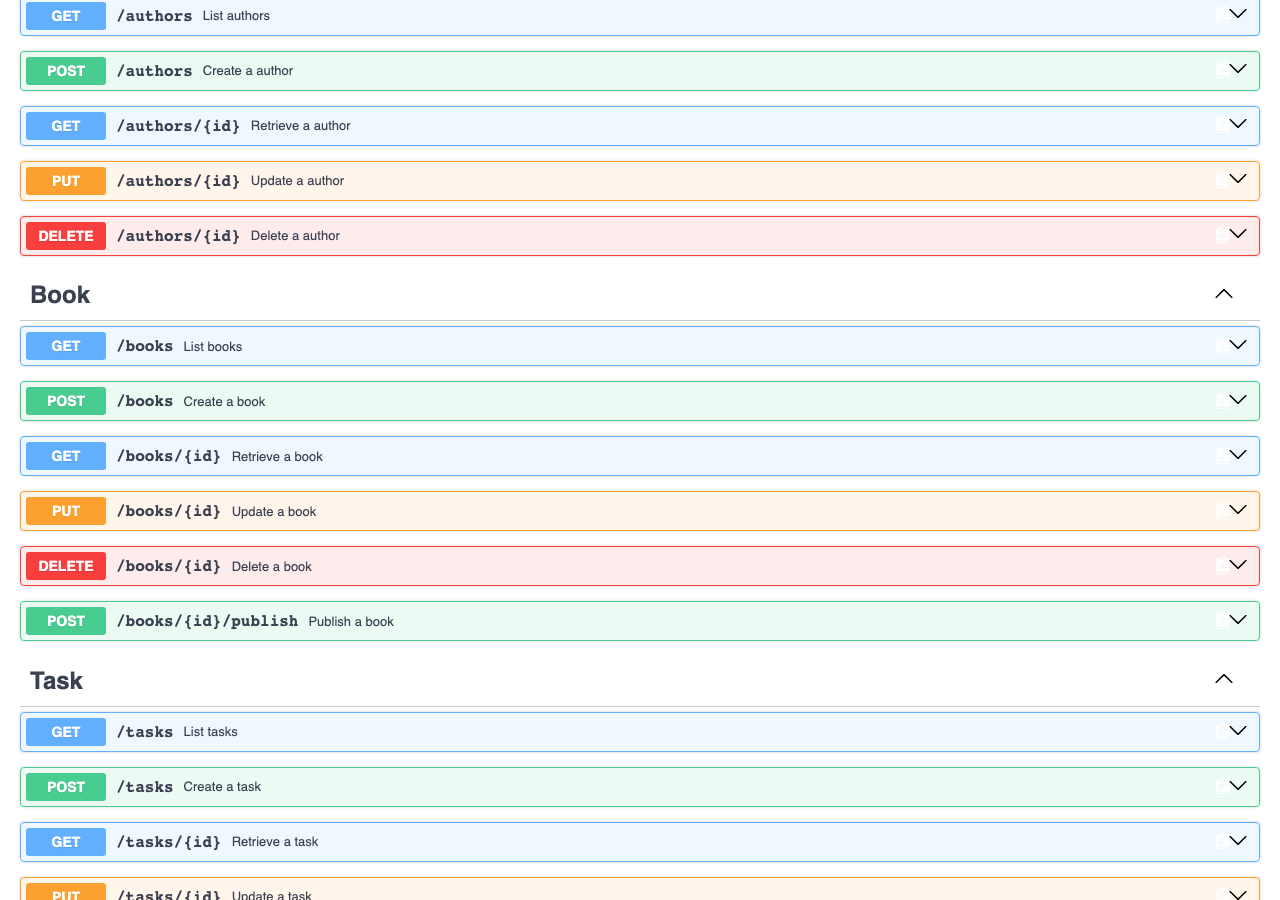
One call serves the merged document as JSON plus a rendered UI, both fully embedded:
app.MountDocs(mux, "/docs", docsui.SwaggerUI())MountDocs serves the UI at path + "/" and issues a 301 redirect from
the bare path to it. This isn’t cosmetic: a DocsUI’s Index HTML
references its Assets by relative filename, and those only resolve
correctly against the trailing-slash URL — visiting /docs directly
(no trailing slash) would otherwise leave the browser resolving
swagger-ui.css against the wrong base path.
Assets are vendored under docsui/swagger-ui/ and docsui/redoc/ and
served via go:embed — there is no external CDN dependency, so the docs
UI works offline and isn’t subject to a third party changing or removing
a hosted asset out from under you.
Swapping the UI
ui is the docsui.DocsUI interface, not a hardcoded renderer, so
switching renderers is a one-line change:
app.MountDocs(mux, "/docs", docsui.ReDoc())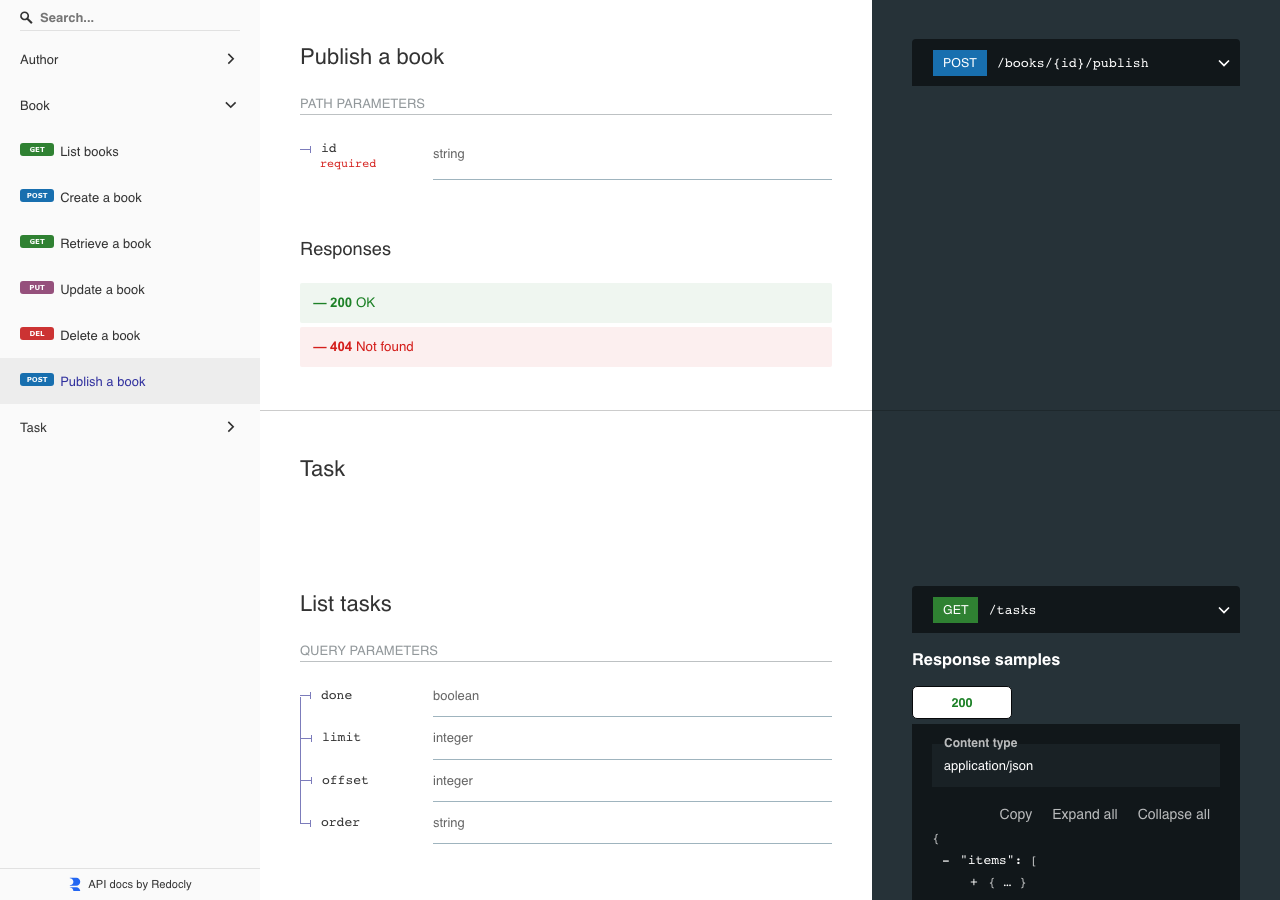
Both ship built in with their own vendored assets. Pick whichever fits your team — Swagger UI’s try-it-out console is often preferred for day-to-day API exploration, ReDoc’s three-pane layout for a cleaner reference document.
Custom actions are documented too
An Action with a non-empty Summary (see
Adding Custom Routes Beyond CRUD) gets a path entry in the
generated OpenAPI() output alongside the CRUD routes, tagged the same
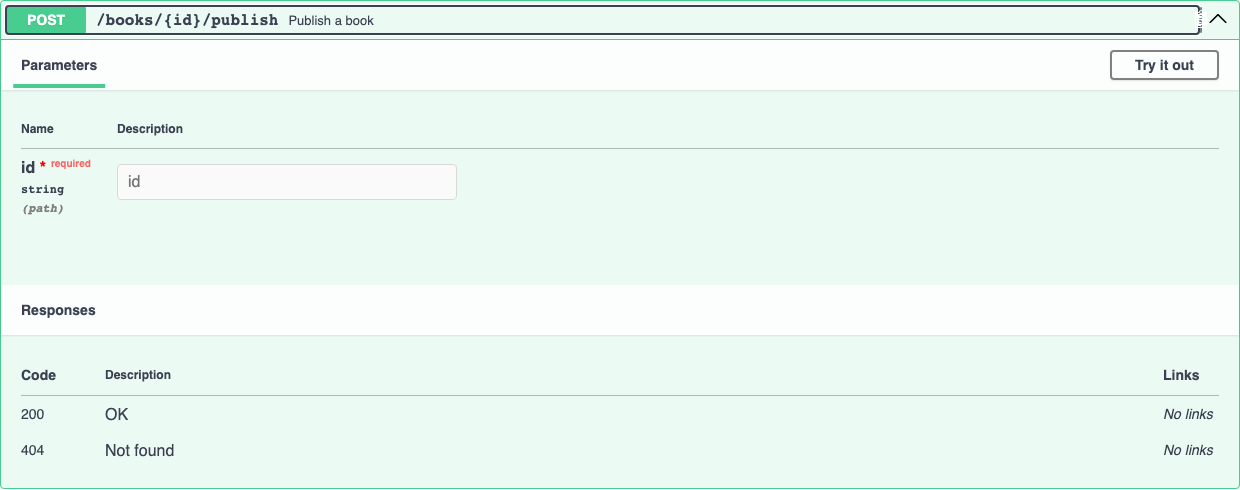
way. examples/prototype’s POST /books/{id}/publish shows up in the
UI exactly like the generated routes around it, including its id path
parameter and declared 200/404 responses:
Leave Summary empty on an Action to mount it without documenting it
— useful for an internal-only route you don’t want showing up in the
public spec.
Implementing your own DocsUI
docsui.DocsUI is a two-method interface:
type DocsUI interface {
    Index(specURL string) []byte
    Assets() (fs.FS, string)
}
Index returns the HTML page for the UI, given the URL the JSON spec is
served from; Assets returns a filesystem of static assets (CSS, JS)
plus the URL prefix they’re served under. Implement it to wire in a
renderer other than Swagger UI or ReDoc — SwaggerUI()/ReDoc() are
convenience constructors, not the only supported option.
Grouping routes
Every operation in a resource’s fragment carries
BaseResource.OpenAPITags() as its OpenAPI tags — this is what
determines how a rendered UI groups a resource’s routes together. It
defaults to the model name; override it before Register:
bookAPI := api.NewBookResource(db)
bookAPI.SetOpenAPITags("Catalog")
Excluding a resource from the document
To keep a resource’s routes mounted while leaving it out of the merged
spec, call ExcludeFromDocs() before passing it to Mount:
internalAPI := api.NewAuditResource(db)
internalAPI.ExcludeFromDocs()

app.Mount(mux, api.NewTaskResource(db), internalAPI)
Mount checks this via BaseResource.DocsExcluded(). To skip
documenting a resource entirely and bypass Mount’s bookkeeping
altogether, call its Register(mux) directly instead of going through
Mount.
Security schemes come from the same objects that enforce auth
openapi.Operation carries a Security field, and the document’s
Components.SecuritySchemes are populated from the same
goninja.Authenticator values passed to Config.DefaultAuth.Auth or a
resource’s ResourceConfig.Auth overrides — not a separate,
hand-maintained description of your auth scheme. A generated OpenAPI()
resolves each route’s required Authenticators through the identical
logic Protect uses to enforce them at request time, so what the
document says is protected and what actually is protected cannot
diverge. See Global Auth and Middleware for how
Authenticators are configured.